
Advanced Air Mobility and eVTOL: Revolutionising Business Aviation

The business aviation industry, renowned for its flexibility, efficiency, and premium travel solutions, is undergoing a seismic shift with the emergence of Advanced Air Mobility (AAM) and electric Vertical Take-Off and Landing (eVTOL) aircraft. These technologies promise to redefine business travel by offering faster, greener, and more accessible alternatives to traditional jets and helicopters. AAM, encompassing eVTOLs and other next-generation aircraft, is set to integrate into urban and regional airspaces, creating new opportunities for business aviation stakeholders. With companies like Joby Aviation, Archer Aviation, and Lilium nearing commercialization in 2025, the sector is poised for growth, supported by significant investments and regulatory advancements. This article explores AAM and eVTOL’s transformative impact on business aviation, with a focus on established companies integrating these technologies, leading innovators, and the broader implications, supported by industry data, expert insights, and critical analysis of opportunities, challenges, and regulatory considerations.
The Rise of AAM and eVTOL in Business Aviation
AAM leverages highly automated, electrically powered aircraft, primarily eVTOLs, to transport people and cargo in urban, suburban, and regional settings. Unlike traditional business jets requiring runways, eVTOLs operate from compact vertiports, enabling point-to-point travel with minimal infrastructure. The National Business Aviation Association (NBAA) highlights AAM’s potential to serve underserved routes, offering quieter, more cost-effective, and sustainable alternatives to helicopters or light jets.
The business aviation sector is well-suited to adopt AAM due to its emphasis on on-demand, high-value travel. Industry reports project robust growth: the AAM market was valued at $11.5 billion in 2024 and is expected to grow at a 20.6% CAGR through 2034. The eVTOL aircraft market alone is projected to reach $4.67 billion by 2030, with 5,280 units delivered by 2035, driven by applications in air taxis, cargo, and emergency services. Honeywell’s 2025 Global Business Aviation Outlook forecasts 8,500 new business jet deliveries worth $280 billion over the next decade, with eVTOLs complementing this growth for short-range missions.
Key Features of eVTOLs
eVTOLs offer distinct advantages for business aviation:
- Electric Propulsion: Zero-emission electric or hybrid-electric systems reduce operating costs and align with sustainability goals.
- Vertical Take-Off and Landing: Eliminates runway dependency, enabling operations in urban centers or remote locations.
- Automation: Advanced AI and autonomy enhance safety and reduce pilot workload.
- Low Noise Footprint: Significantly quieter than helicopters, ideal for urban environments.
These features position eVTOLs for applications like executive shuttles, airport transfers, and regional business travel, offering time savings over ground transportation.
Established Business Aviation Companies Integrating eVTOLs
Several established business aviation companies are strategically integrating eVTOLs into their service offerings, leveraging their expertise in premium travel and infrastructure to capitalize on AAM’s potential.
- Signature Aviation: As the world’s largest network of private aviation terminals, Signature Aviation is electrifying its 200+ airport terminals to support eVTOL operations. A memorandum of understanding (MOU) with Archer Aviation and Beta Technologies focuses on installing interoperable rapid recharging systems across its network, targeting key United Airlines hubs like Newark (EWR) and Chicago O’Hare (ORD) for air taxi services by late 2025. This move enhances Signature’s role as a critical infrastructure provider, bridging traditional business aviation with AAM.
- Jetex: A global leader in private jet services, Jetex is partnering with Archer Aviation to design passenger experiences and deploy charging infrastructure for Archer’s Midnight eVTOL aircraft. This collaboration aims to integrate eVTOLs into Jetex’s premium service portfolio, offering seamless urban air mobility solutions for high-net-worth clients.
- Volare Aviation: Through its subsidiary eVolare, UK-based Volare Aviation, a major helicopter and private jet operator, has ordered four Lilium Jets with an option for 10 more, signaling a commitment to integrating eVTOLs into its luxury aviation services. This move positions Volare to offer sustainable, point-to-point travel in the UK market.
- Saudia Private: The Saudia Group, a prominent Middle Eastern aviation operator, signed a sales agreement with Lilium for up to 100 eVTOL Jets, the largest commitment by an airline operator to date. This deal reflects Saudia’s strategy to diversify its premium aviation offerings with sustainable, short-range air taxi services.
These companies are leveraging their existing networks, customer bases, and operational expertise to transition into AAM, positioning themselves as early adopters in a rapidly evolving market. Their involvement validates eVTOLs as a viable extension of business aviation, particularly for urban and regional connectivity.
Leading eVTOL Companies in 2025
The eVTOL sector is led by a mix of innovative startups and established aerospace giants, each advancing unique designs and business models to capture market share. The following companies are at the forefront in 2025:
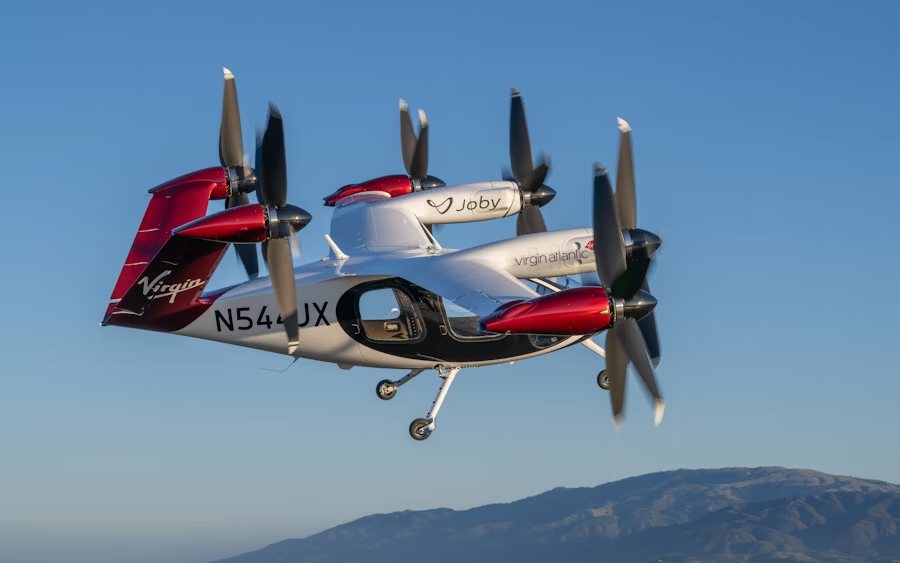
- Joby Aviation: A pioneer since 2009, Joby is a leader in eVTOL development, targeting commercial air taxi services by 2025. Its S4 eVTOL, capable of carrying a pilot and four passengers over 150 miles at 200 mph, has completed over 1,000 test flights. Joby’s partnerships with Delta Air Lines for city-to-airport services in New York and Los Angeles, and a $60 million investment from Delta, underscore its market traction. Joby’s recent hydrogen eVTOL (H2eVTOL) demonstrator flew 523 miles, showcasing extended-range potential. The company has completed 40% of the FAA’s fourth certification phase, aiming for type inspection authorization (TIA) in 2025. JoeBen Bevirt, Joby’s CEO, emphasizes, “This milestone demonstrates Joby’s continued industry leadership and the maturity of our test program.â€
- Archer Aviation: Archer’s Midnight eVTOL, designed for four passengers and a pilot with a 100-mile range, is optimized for rapid, back-to-back urban trips. With a $500 million order from Japan Airlines and Sumitomo’s Soracle joint venture, Archer’s order book exceeds $6 billion. The company’s consortium with the Abu Dhabi Investment Office aims to launch air taxi services in the UAE by late 2025, supported by partnerships with Falcon Aviation and Etihad Aviation Training. CEO Adam Goldstein notes, “Scaling globally requires the right infrastructure,†highlighting Archer’s focus on vertiport integration.
- Vertical Aerospace: The UK-based company’s VX4 eVTOL, designed for four passengers and a 100-mile range, targets certification by 2026 under EASA regulations. With pre-orders from American Airlines, Virgin Atlantic, and Avolon totaling over 1,300 units, Vertical has strong airline backing. Despite a setback with Rolls-Royce terminating its propulsion agreement, Vertical’s collaboration with Honeywell for flight controls ensures technological progress.
- Eve Air Mobility: A spinoff of Embraer, Eve is developing a four-to-six-passenger eVTOL with a helicopter-like design, planning for autonomous operations in the future. United Airlines has committed to purchasing up to 400 units, with deliveries expected by 2026. Eve’s focus on cost-efficient, quieter alternatives to helicopters aligns with business aviation’s premium service model.
- Beta Technologies: Beta’s ALIA VTOL (A250) and CTOL (CX300) aircraft target both passenger and cargo applications, with a noise profile one-tenth that of helicopters. Metro Aviation’s order for up to 20 eVTOLs and Air New Zealand’s acquisition of a technical demonstrator for 2025 operations highlight Beta’s versatility. Beta’s CEO, Kyle Clark, conducted the first flight of its production-configuration CX300 in November 2024, marking a certification milestone.
- Wisk Aero: A Boeing subsidiary, Wisk is developing an autonomous four-passenger eVTOL with a 90-mile range, unveiled in 2022. Boeing’s financial backing and Wisk’s acquisition of Verocel for certification expertise bolster its progress toward commercial operations.
These companies lead the eVTOL field due to their advanced testing, strategic partnerships, and regulatory progress, positioning them to shape the AAM market.


Impacts on Business Aviation
Opportunities for Growth
AAM and eVTOLs create significant opportunities for business aviation operators. Established players like Signature Aviation and Jetex can expand their service portfolios by integrating eVTOLs, offering seamless urban-to-airport connectivity. Delta Air Lines’ investment in Joby Aviation exemplifies how airlines can enhance their share of the travel journey, with Max Fenkell, Joby’s policy lead, noting, “Recognizing the unique characteristics of each airport is central to unlocking AAM’s significant opportunity.†Morgan Stanley projects the AAM market could reach $1 trillion by 2040, with urban air mobility (UAM) valued at $1.5 trillion, signaling robust demand for business travel applications.
eVTOLs appeal to high-net-worth individuals and corporations seeking efficient, private travel options. For instance, Saudia Private’s order of up to 100 Lilium Jets reflects the demand for premium, sustainable transport in the Middle East. These aircraft could reduce travel times for short-haul routes, such as a 90-minute ground trip shortened to 10 minutes by Archer’s Midnight eVTOL.
Challenges and Critical Considerations
Despite the promise, integrating eVTOLs presents challenges:
- Infrastructure Costs: Vertiports and charging stations require significant investment. The FAA’s Engineering Brief 105A outlines vertiport standards, but urban land constraints increase costs.
- Public Acceptance: Noise, safety, and social equity concerns could hinder adoption. Judy Ross, assistant director at San Jose Norman Y. Mineta International Airport, emphasizes, “We have put together a detailed analysis on what the future holds for U.S. airports as the AAM industry moves forward,†highlighting the need for community engagement.
- Workforce and Supply Chain: Shortages of pilots and technicians, coupled with supply chain disruptions, challenge scalability. AI-driven tools, as adopted by companies like Icarus Jet, can mitigate downtime but require investment.
Policy and Regulatory Considerations
The regulatory landscape is evolving to support AAM, but challenges remain. The FAA’s 2023 classification of eVTOLs as powered-lift aircraft under Part 21.17(b) clarified certification paths, with Joby receiving a unique airworthiness certificate in 2023. The FAA’s powered-lift Special Federal Aviation Regulation (SFAR), finalized in 2024, targets commercial operations by 2025. A five-nation partnership (U.S., UK, Australia, Canada, New Zealand) announced in June 2025 aims to streamline eVTOL certification, fostering a $50 billion market. Adam Goldstein of Archer Aviation calls this “a major move to streamline global certification of eVTOL aircraft.â€
Globally, regulatory progress varies. The UK CAA targets eVTOL operations by 2026, while China’s CAAC certified EHang’s EH216-S in 2023. Australia’s CASA emphasizes safety and community engagement in its eVTOL roadmap. Key considerations include:
- Airworthiness Certification: EASA’s Special Condition for VTOL and FAA standards ensure safety.
- Pilot Training: Companies like CAE and Volocopter are developing AAM-specific training programs.
- Air Traffic Management: NASA’s research on Unmanned Aircraft System Traffic Management (UTM) supports safe integration into low-altitude airspace.
- Infrastructure Standards: Vertiport approvals and charging infrastructure must align with local regulations.
Industry Leader Perspectives
Leaders are optimistic but pragmatic. Bonny Simi of Joby Aviation sees eVTOLs enabling “a healthier and fulfilling work-life balance†for pilots through sustainable air taxis. Billy Nolen, Archer’s chief safety officer and former FAA Acting Administrator, stresses, “Safety is sacrosanct,†underscoring the need to maintain aviation’s safety record. Whilst Andre Stein of Eve Air Mobility also highlights focus on “delivering the aircraft to market,†emphasizing practical commercialization over demonstrators.
Benefits for Business Aviation
eVTOLs offer compelling features, advantages, and benefits:
- Features: Electric propulsion, vertical take-off, and automation enable flexible, low-cost operations.
- Advantages: Zero emissions, lower operating costs (up to 50% less than helicopters), and urban vertiport access enhance efficiency.
- Benefits: Faster travel times, expanded market reach, and alignment with corporate sustainability goals attract new customers and strengthen brand value.
For example, eVTOLs could replace helicopters for executive transport, offering quieter, greener alternatives. Aviation Week projects 1,000 eVTOL deliveries by 2030, scaling to 10,000 by 2040.
Critical Analysis
While AAM’s potential is vast, overhyping timelines risks disillusionment. Joby and Archer target 2025 launches, but delays in certification or infrastructure could push timelines to 2026, as seen with Joby’s shift from 2024. Lilium’s insolvency proceedings highlight financial risks, emphasizing the need for sustainable funding. Social equity is critical, ensuring AAM benefits underserved communities, not just affluent travelers. Established operators like Signature and Jetex must balance high capital expenditures with long-term profitability.
Conclusion: A Transformative Future for Business Aviation
AAM and eVTOLs are poised to revolutionize business aviation, with established players like Signature Aviation, Jetex, Volare Aviation, and Saudia Private integrating these technologies to enhance their premium offerings. Leading innovators—Joby, Archer, Vertical, Eve, Beta, and Wisk—are driving the sector forward with advanced designs and strategic partnerships. With a projected $1 trillion market by 2040, AAM offers significant growth opportunities, supported by regulatory progress like the FAA’s SFAR and global certification agreements.
For business aviation, eVTOLs promise faster airport shuttles, access to remote destinations, and alignment with sustainability goals, enhancing competitiveness. However, operators must navigate infrastructure costs, regulatory complexities, and public acceptance to succeed. As Pulkit Agrawal of Honeywell notes, “Nothing will be allowed to fly unless it’s safe,†reinforcing safety’s primacy. By embracing AAM, business aviation can lead the charge in redefining air travel, delivering a future where efficiency, sustainability, and accessibility soar to new heights.